Monetization
Affiliate Marketing Explained: How It Works and What It Actually Pays
Affiliate marketing pays when a tracked recommendation leads to an approved sale, lead, or subscription. This guide explains how tracking, attribution, commission models, reversals, disclosures, and payouts work—and what actually determines affiliate income.
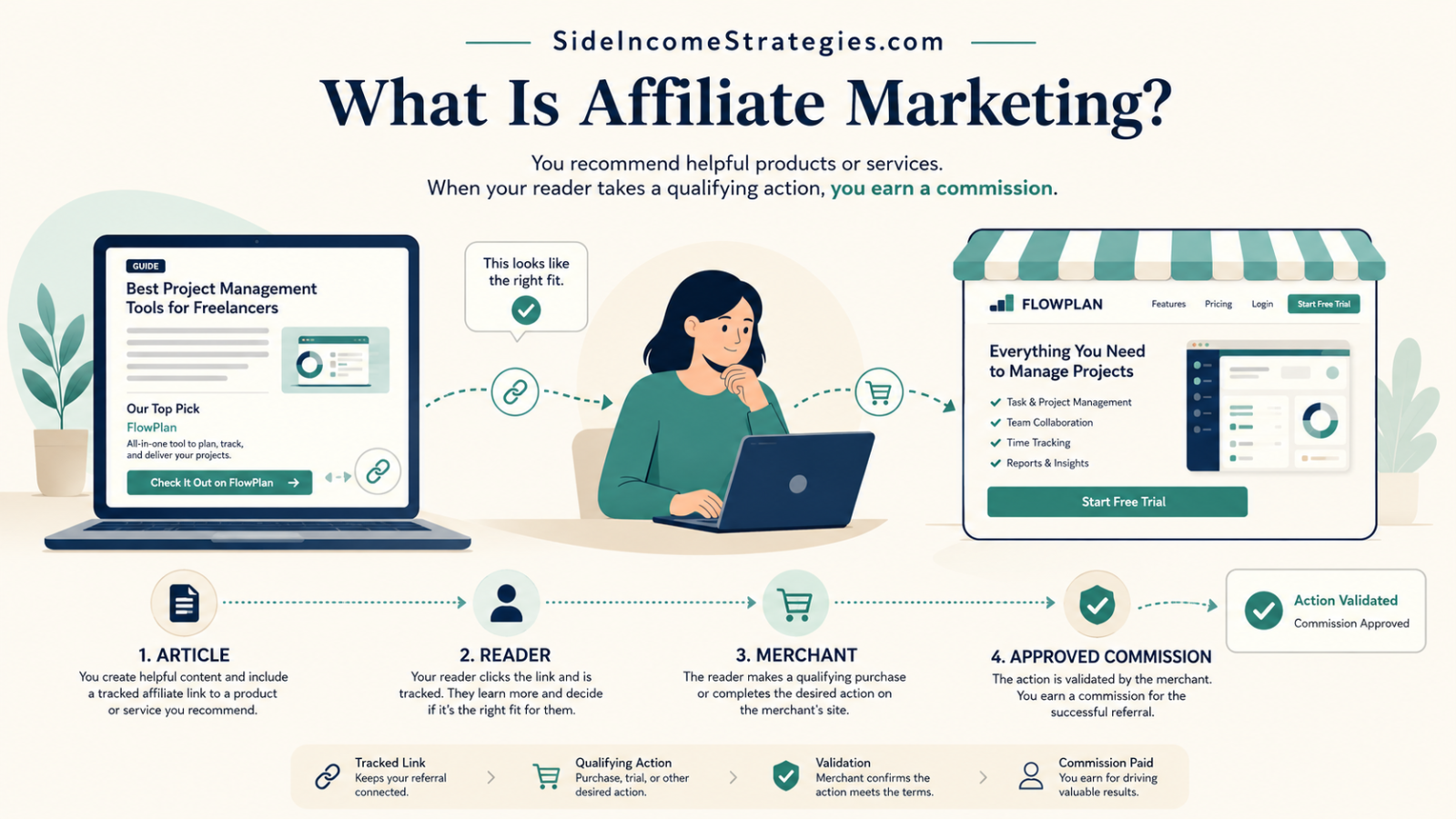
Affiliate marketing is mechanically simple: you recommend a product or service, someone follows your tracked link, and the merchant may pay you when that person completes a qualifying action.
The difficult part is everything between the recommendation and the approved commission.
The visitor must have a reason to care. The recommendation must fit the problem being discussed. The merchant must convert the visitor. The purchase must qualify under the program’s rules. It may then remain pending until returns, cancellations, fraud checks, or other conditions have been resolved.
That is why a headline commission rate tells you surprisingly little on its own.
This guide explains how the complete system works, which commission models exist, what controls the amount an affiliate earns, where links belong, and how to recommend products without damaging reader trust.
How Affiliate Marketing Works
Affiliate marketing connects three main parties:
- The affiliate or publisher creates the recommendation.
- The reader or potential customer follows the recommendation.
- The merchant sells the product or service and funds the commission.
An affiliate network or tracking platform may operate between the affiliate and merchant, providing tracked links, reporting, attribution, validation, and payment processing.
The affiliate is not normally paid merely because somebody sees or clicks a link. Payment depends on the program’s qualifying action, which might be a completed purchase, a new customer, a subscription, a lead, or another defined result. Fiverr, for example, states that its affiliate program pays for qualifying purchases rather than clicks or registrations.
How Tracking, Attribution, and Payment Work
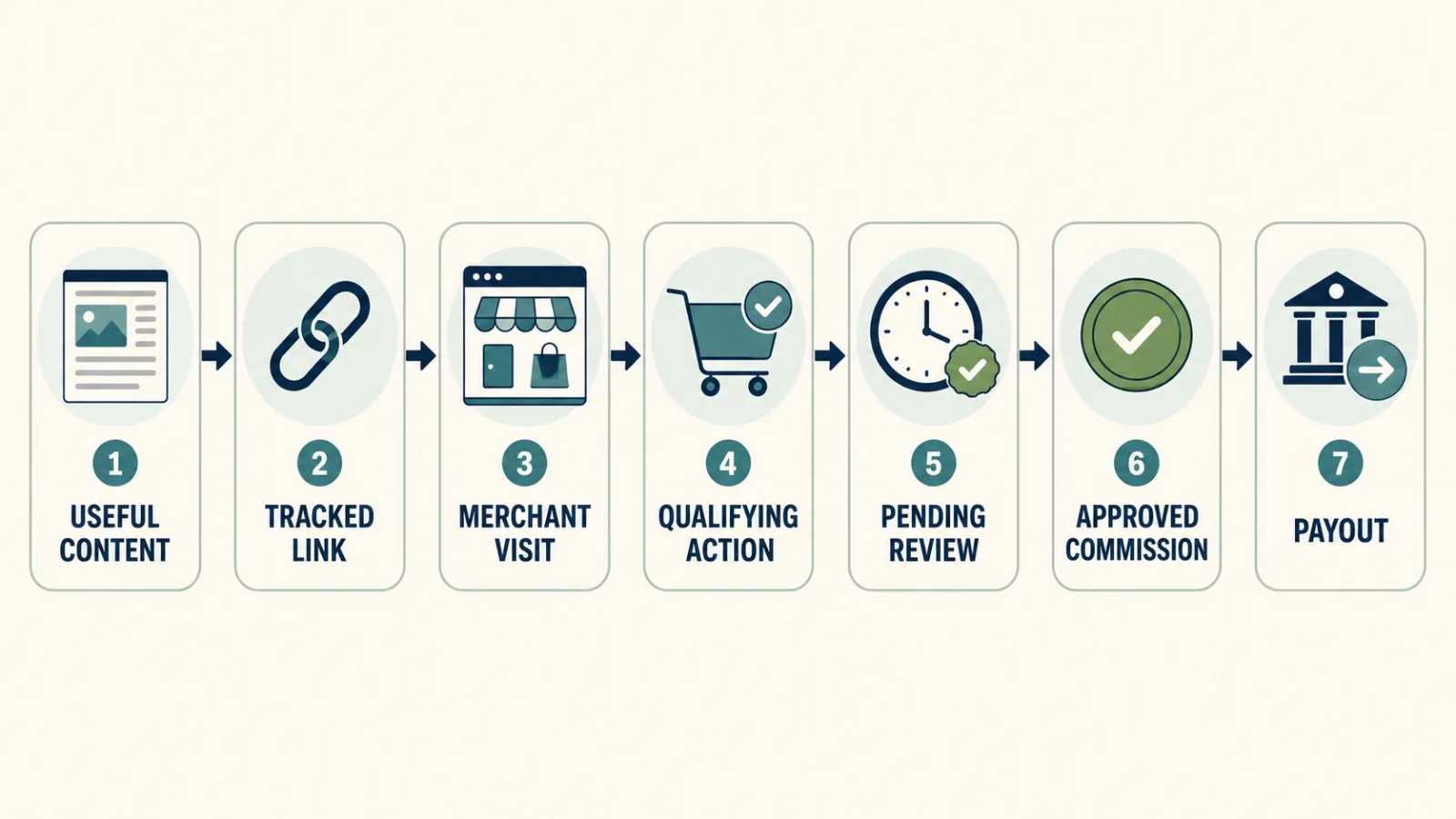
- 1
The Affiliate Creates a Tracked Link
The link contains an affiliate ID or another tracking parameter that identifies the referring publisher.
- 2
A Reader Clicks the Link
The merchant or affiliate platform records the referral using its chosen tracking system.
- 3
An Attribution Window Begins
The program defines how long the referral can remain eligible and what happens if the customer clicks another affiliate’s link before buying.
- 4
The Customer Completes a Qualifying Action
Depending on the program, this may be a purchase, subscription, lead, trial conversion, or another approved action.
- 5
The Commission Remains Pending
The merchant may wait for the product to ship, a return period to expire, or fraud and eligibility checks to finish.
- 6
The Commission Is Approved or Reversed
Returned orders, cancellations, fraud, invalid customer information, or actions outside the program terms may cause a pending commission to be reversed.
- 7
The Affiliate Is Paid
Payment follows the program’s payout schedule, threshold, currency, and available payment methods. Amazon Associates, for example, says qualifying commission income is generally paid approximately 60 days after the end of the earning month.
Common Affiliate Commission Models
Affiliate programs do not all pay in the same way. The commission model should match the merchant’s economics and the action the affiliate is expected to generate.
| Commission Model | What Triggers Payment | Common Use | Important Detail |
|---|---|---|---|
| Percentage of Sale | A percentage of an approved order value | Retail, ecommerce, physical products | The calculation may exclude taxes, shipping, discounts, refunds, or certain products |
| Fixed Fee / CPA | A fixed amount for a qualifying customer or purchase | Software, services, finance, marketplaces | Confirm whether the customer must be new and whether different products pay different amounts |
| Lead Commission | A payment for a qualified lead or completed application | Insurance, finance, home services, B2B | A submitted form may still need to satisfy quality and eligibility rules |
| Recurring Commission | Repeated commission while the referred customer remains eligible | SaaS, memberships, subscriptions | Recurring payments may be capped by time, customer status, or program terms |
| Hybrid Commission | A first-purchase fee plus later revenue share | Marketplaces, SaaS, service platforms | The initial and recurring portions may follow different rules |
| Tiered Commission | The rate or bonus changes with approved volume or status | Larger affiliate programs | Higher tiers may require sustained performance or specific eligibility |
What Real Affiliate Programs Currently Pay
| Program Example | Current Public Structure | What It Demonstrates |
|---|---|---|
| Amazon Associates | Category-based percentage commissions with different rates for different product categories | A large product catalog can contain substantially different economics within one program |
| HubSpot | 30% recurring commission for up to one year and a stated 180-day cookie window | Recurring SaaS commissions and a comparatively long attribution window |
| Fiverr Marketplace | 25% of a new buyer’s first order plus 10% revenue share on later orders for 12 months | A hybrid structure combining first-purchase CPA and later revenue share |
| Fiverr Logo Maker | $30 for the first qualifying order plus 10% revenue share on later orders for 12 months | A fixed first-purchase commission combined with recurring revenue share |
Amazon’s current U.S. commission schedule demonstrates why “Amazon pays X percent” is an incomplete statement: rates vary by product category, and some categories may pay no standard commission at all. Amazon also generally uses a 24-hour session after the affiliate click, although qualifying products placed in the cart during that session may remain eligible longer under its stated rules.
HubSpot currently advertises a 30% recurring commission for up to one year and a 180-day cookie window. Fiverr currently publishes hybrid plans combining a percentage of the first order with revenue share from later purchases. These examples show that commission rate, duration, attribution, and customer eligibility must be evaluated together.
What Affiliate Marketing Actually Pays
There is no meaningful universal answer to how much affiliate marketing pays.
Two websites with the same amount of traffic can earn completely different amounts. One may attract readers who are actively comparing products. The other may attract a much larger audience with no immediate reason to buy.
A useful simplified equation is:
Each part matters:
- Relevant visits: people whose problem or buying decision matches the recommendation
- Affiliate click rate: the share who continue to the merchant
- Merchant conversion rate: the share of referred visitors who complete the qualifying action
- Average approved commission: the amount left after eligibility checks, cancellations, refunds, and reversals
A Hypothetical High-Intent Example
Suppose a comparison guide receives 1,000 relevant visits.
If 15% of readers click an affiliate link, 4% of those visitors complete an approved purchase, and the average approved commission is $30:
1,000 × 15% × 4% × $30 = $180
A Hypothetical Broad-Traffic Example
Now suppose a general article receives 10,000 visits, but only 1% click the affiliate link and 1% of those clicks convert at the same $30 commission:
10,000 × 1% × 1% × $30 = $30
What Determines Affiliate Earnings
- 1
Audience and Product Fit
The product must solve a problem the reader actually has. A strong commission cannot compensate for an irrelevant recommendation.
- 2
Reader Intent
Someone searching for a product comparison, alternative, price, setup guide, or specific solution is usually closer to a decision than someone reading a broad introductory article.
- 3
The Merchant’s Ability to Convert
The affiliate can send a qualified visitor, but the merchant controls the product page, checkout, pricing, trial, trust signals, and much of the final conversion experience.
- 4
Commission Structure
A percentage commission, fixed bounty, lead payment, recurring commission, or hybrid plan can produce very different economics.
- 5
Average Order or Customer Value
A lower commission rate on a valuable purchase may produce more revenue than a higher percentage on a low-value product.
- 6
Attribution Rules
Cookie duration, last-click rules, cross-device tracking, new-customer requirements, and excluded products determine which conversions receive credit.
- 7
Reversals and Approval Rules
Tracked revenue is not the same as approved revenue. Refunds, cancellations, chargebacks, fraud, and program exclusions can reduce the final amount.
- 8
Payment Terms
A commission is not cash in the bank until it passes the locking period, reaches the minimum payout threshold, and is paid according to the program schedule.
A High Commission Rate Does Not Guarantee a Good Program
It is easy to compare affiliate programs by the largest number shown on the signup page.
That number does not tell you whether your audience wants the product, whether the merchant converts, whether commissions are regularly reversed, or whether the program credits the type of customer you can realistically refer.
| Factor | Program A | Program B |
|---|---|---|
| Headline Rate | Higher | Lower |
| Audience Fit | Weak | Strong |
| Merchant Trust | Unclear | Established |
| Conversion Experience | Complicated | Clear |
| Attribution Terms | Restrictive | Suitable for the buying cycle |
| Refund / Reversal Risk | High | Lower |
| Likely Practical Value | Uncertain | Potentially stronger despite the lower rate |
A good affiliate program is not simply the one that pays the highest percentage. It is the one where audience fit, merchant quality, attribution, approval rules, and commission economics work together.
Where Affiliate Links Belong
An affiliate link works best when it completes a useful explanation.
The recommendation should make sense even if no commission were available.
Works well
- Inside a tutorial step where the recommended tool performs the task being explained
- In a comparison where the reader is actively evaluating alternatives
- In a resource section after the product’s purpose, strengths, and limitations have been explained
- In an article addressing a specific buying decision
- Beside a clear explanation of who the product is and is not suitable for
- In an updated recommendation based on current terms, features, and availability
Avoid
- Adding unrelated links merely because a program pays well
- Repeating the same affiliate link throughout every paragraph
- Showing aggressive pop-ups before the reader receives any value
- Using vague buttons that hide where the link leads
- Publishing discounts, prices, features, or promotions that are no longer accurate
- Presenting advertising copy supplied by the merchant as an independent editorial conclusion
Affiliate terms can impose additional restrictions. Amazon, for example, requires accurate product information and says references to limited-time promotions should be removed when the promotion ends.
Can You Recommend a Product You Have Not Used?
Direct experience is valuable, but not every useful affiliate article has to be a personal review.
You can create a research-based comparison using official documentation, pricing information, product demonstrations, independent testing, customer-support policies, and clearly identified third-party evidence.
What you cannot do is imply an experience you did not have.
The FTC states that endorsers should not talk about their experience with a product they have not tried or misrepresent how regularly they use it.
A researched recommendation can still be useful. It simply needs to be accurate about what was examined and what was not.
Affiliate Disclosure Is Part of the Recommendation
For content directed at U.S. consumers, affiliate relationships should be disclosed clearly and conspicuously.
The FTC says the disclosure should be close to the recommendation or affiliate link. A disclosure buried in a footer or on a separate disclosure page may not give the reader the necessary context at the moment the endorsement is seen. The FTC also warns that the words “affiliate link” by themselves may not clearly explain that the publisher can earn money.
A standalone Affiliate Disclosure page is still useful, but it does not replace an appropriate disclosure near monetized recommendations.
Mark Affiliate Links for Search Engines
Google recommends marking affiliate and other paid links with rel="sponsored". Google says nofollow remains acceptable for this purpose, but sponsored is preferred.
What to Check Before Joining an Affiliate Program
- 1
Audience Relevance
Does the product solve a real problem for the people you already reach or intend to reach?
- 2
The Qualifying Action
Are you paid for a sale, a new customer, a lead, a subscription, or another event?
- 3
Commission Calculation
Is the commission fixed, percentage-based, recurring, tiered, or hybrid? Is it calculated before or after discounts, taxes, shipping, and refunds?
- 4
Attribution Window
How long after the click can an eligible action occur?
- 5
Attribution Model
Can another affiliate, coupon site, paid campaign, or later click replace your referral?
- 6
Customer Eligibility
Does the program pay only for new customers, selected products, certain regions, or specific plans?
- 7
Validation and Reversals
How long are commissions pending, and which events can cancel them?
- 8
Payout Terms
Check the threshold, payment schedule, currency, fees, available methods, and tax-information requirements.
- 9
Promotional Restrictions
Review rules covering paid search, email, social media, coupon codes, trademarks, direct linking, discount claims, and brand assets.
- 10
Program Stability
Can the merchant change rates, close the program, remove products, or revise attribution terms? How are affiliates notified?
The Affiliate Metrics That Actually Help
| Metric | What It Measures | Why It Matters |
|---|---|---|
| Affiliate Clicks | How many readers continue to the merchant | Shows whether the recommendation and placement create interest |
| Merchant Conversion Rate | The percentage of affiliate clicks that produce a qualifying action | Reveals whether referred visitors convert after leaving your site |
| Tracked Commission | Commission recorded before final approval | Useful for monitoring activity, but not final revenue |
| Approved Commission | Commission remaining after validation and reversals | The amount that should be used for real performance analysis |
| Earnings per Click | Approved commission divided by affiliate clicks | Helps compare the commercial value of different pages, offers, or merchants |
| Revenue per Visitor | Approved commission divided by relevant page visits | Connects affiliate revenue to the traffic entering your content |
| Reversal Rate | The share of tracked commissions later cancelled | Can reveal refund, fraud, eligibility, or merchant-quality problems |
| Conversion by Page | Which articles or placements produce approved actions | Helps identify the content and intent that drive commercial results |
Do not evaluate performance from clicks alone.
A page with fewer clicks may produce more approved revenue because the visitors are better matched to the product. A high tracked commission can also be misleading if a significant portion is later reversed.
Use approved revenue whenever possible.
How Much Traffic Do You Need?
Affiliate marketing has no universal minimum traffic requirement.
A small article answering a specific commercial question can produce affiliate activity before a broad informational site with much more traffic. Conversely, strong buying intent does not guarantee earnings if the merchant, program terms, product, or recommendation is weak.
The useful question is not:
“How many visitors do I need?”
It is:
“Am I attracting people with the right problem or buying decision, and does the recommendation help them take a sensible next step?”
Traffic volume becomes more valuable when relevance, intent, merchant conversion, and commission economics are already working together.
When Affiliate Marketing Is a Good Fit
Works well
- Affiliate Marketing Fits When
- Your audience regularly needs products, software, services, or providers connected to the topic
- Readers ask comparison, setup, alternative, pricing, or purchasing questions
- You can explain meaningful differences rather than merely listing links
- Relevant merchants offer workable programs
- The recommendation can improve the reader’s decision
- You can update the content when products, prices, or terms change
- The financial relationship can be disclosed without undermining the recommendation
Avoid
- Affiliate Marketing Is a Weak Fit When
- The products have little connection to the content
- Links must be forced into informational pages
- The audience has no realistic buying intent
- The merchant has poor trust, conversion, support, or refund practices
- The program terms make attribution or payment unlikely
- You cannot support the claims being made
- An owned product or service would solve the audience’s need more directly
A Realistic Way to Start
- 1
Start With One Audience Problem
Choose a question, task, or buying decision that already exists.
- 2
Identify Relevant Solutions
List the products or services that genuinely address the problem, whether or not they currently have affiliate programs.
- 3
Inspect the Programs
Compare commission structure, attribution, qualifying actions, reversals, payout terms, restrictions, and merchant quality.
- 4
Create the Useful Content First
Write the tutorial, comparison, explanation, or decision guide without treating the affiliate link as the main substance.
- 5
Add Links Where They Complete the Explanation
The reader should understand why the product is mentioned and who it suits before being asked to click.
- 6
Add a Clear Disclosure
Place it where the reader will see it before or alongside the monetized recommendation.
- 7
Use the Correct Link Attribute
Mark affiliate links with rel="sponsored".
- 8
Track Approved Results
Monitor clicks, merchant conversion, reversals, approved commission, and performance by page.
- 9
Update or Remove Weak Recommendations
If the product changes, the merchant becomes unreliable, the program terms deteriorate, or the recommendation stops helping readers, revise the content.
Affiliate Marketing Is a Revenue Model, Not a Shortcut
Affiliate marketing works when a publisher helps the right person make a better decision and the merchant pays for the resulting commercial action.
The tracked link is only the mechanism.
The underlying value comes from understanding the audience, selecting relevant products, explaining tradeoffs accurately, earning trust, and maintaining the recommendation as conditions change.
A high commission cannot rescue weak content. Large traffic cannot rescue poor audience fit. A clear disclosure does not weaken a useful recommendation; it tells readers how the business relationship works.
The practical goal is not to place the largest possible number of links.
It is to build a smaller number of recommendations that remain useful even when the commission is visible.
Frequently asked questions
- How much can a beginner earn from affiliate marketing?
- There is no dependable beginner average. Earnings depend on relevant traffic, reader intent, affiliate click rate, merchant conversion, commission structure, attribution, and reversals. Some sites earn nothing for long periods, while a smaller high-intent audience can occasionally produce commissions earlier.
- Do affiliate marketers get paid for clicks?
- Most retail and SaaS affiliate programs pay for a qualifying action such as a purchase, subscription, or approved lead rather than the click itself. The click starts the tracking process but does not guarantee commission.
- What is an affiliate cookie window?
- It is the period during which a qualifying action may be attributed to the affiliate after a tracked click. The exact window and attribution rules vary by program, and a later click from another source may sometimes replace the original referral.
- Do I need to use every product I recommend?
- You must not imply personal experience you do not have. A hands-on review requires genuine use. A research-based comparison can still be useful if it clearly explains that it is based on documentation, demonstrations, pricing, policies, or other identified evidence.
- Do I have to disclose affiliate links?
- For U.S.-directed content, the FTC says material affiliate relationships should be disclosed clearly and conspicuously near the recommendation or link. A separate disclosure page alone is not always sufficient.
- Is affiliate marketing passive income?
- Existing content can continue generating referrals after publication, but the business still requires traffic, accurate recommendations, link maintenance, program monitoring, disclosure compliance, and updates when products or terms change.
- Which affiliate commission model is best?
- No commission model is universally best. A lower percentage from a relevant, trusted merchant may outperform a larger rate from a poor-fit program. Compare audience fit, merchant conversion, customer value, attribution, reversals, and payout terms together.
Related guides
Traffic & Growth
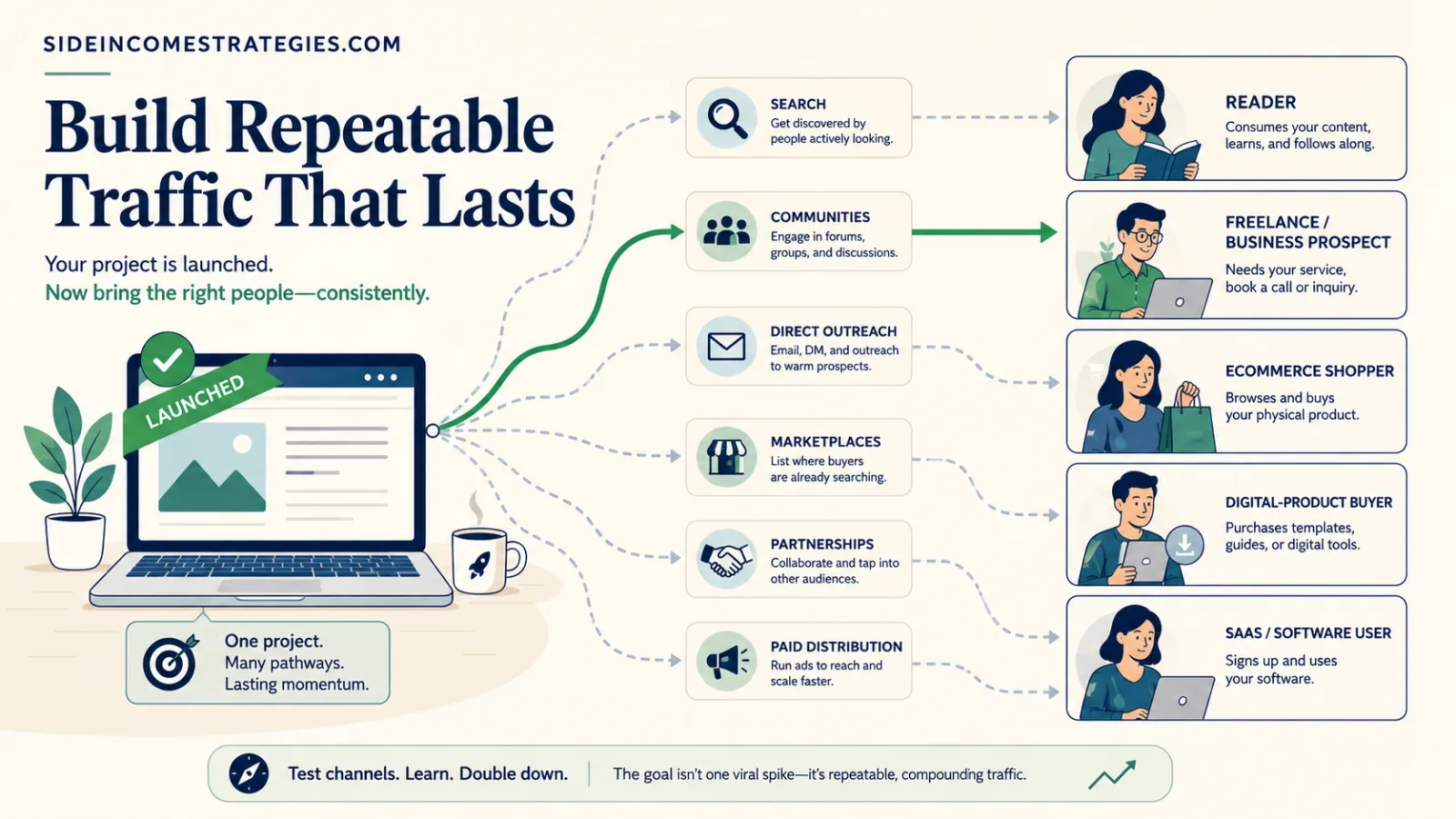
From Launch to Repeatable Traffic: How to Reach the Right People
Building something is only the beginning. The next challenge is finding a reliable way to reach the people who actually need it. This guide explains how to choose traffic channels, run small tests, measure useful signals, and focus on the distribution methods that show real potential.
· 17 min read

Strategies
How to Choose a Side Income Model That Fits Your Life
The right side income model depends less on finding the perfect idea and more on choosing something that fits your time, budget, skills, and expectations. This guide gives you a practical framework for comparing the main options before you commit months of work to one.
· 10 min read

Start & Build
How to Build Your Side Income Project: From Model to Launch
Choosing a side income model is only the first decision. The next step is turning that choice into something real without spending months building the wrong thing. This guide shows how to define your first version, test the biggest assumption, build only what you need, launch small, and look for a real signal before investing more.
· 12 min read