Side Income Strategies
How to Choose a Side Income Model That Fits Your Life
The right side income model depends less on finding the perfect idea and more on choosing something that fits your time, budget, skills, and expectations. This guide gives you a practical framework for comparing the main options before you commit months of work to one.
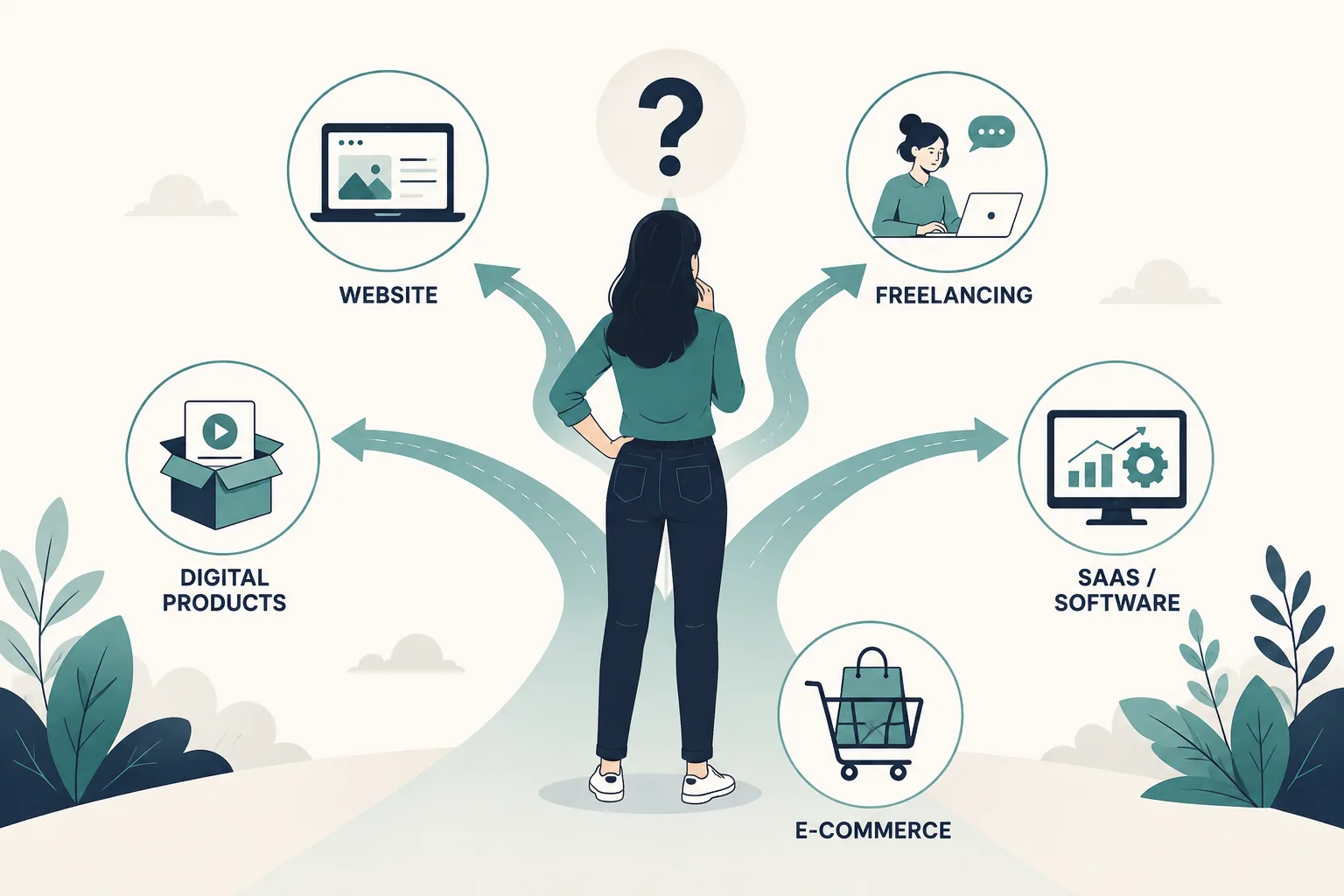
Most people start looking for side income in the wrong place: they search for ideas. That quickly leads to lists of 20, 50, or even 100 ways to make money online. Freelancing sits next to affiliate marketing, selling digital products, content websites, e-commerce, and software as though they are simply different versions of the same thing. They are not. The bigger decision is what kind of income model you want to build. Some models can produce revenue relatively quickly but require you to keep selling your time. Others may take months before they produce anything meaningful, but can leave you with an asset that continues to attract traffic, customers, or revenue after the initial work is done. Before choosing an idea, it helps to choose the type of game you are willing to play.
Start with the model, not the idea
A side income idea describes what you might do. A business model describes how the activity actually turns into money. “Web design” is an idea. Selling website builds to local businesses is a service model. “Cooking” is an interest. Building a recipe website that earns through advertising and affiliate links is a content and advertising model. “AI tools” is a category. Building a small paid software product around a specific problem is a software subscription model. That distinction matters because two ideas that sound similar can create completely different workloads, risks, and timelines. Instead of asking only, “Could I make money doing this?”, ask a more useful question:
Six common side income models
There are countless variations, but most online side-income projects can be grouped into a relatively small number of models. The table below is not meant to declare a winner. It shows why the right choice changes depending on what you value.
| Model | Typical upfront cost | Revenue speed | Scalability | Asset ownership | Platform dependency |
|---|---|---|---|---|---|
| Freelancing | Low | Fast | Low–Medium | Low | Low–Medium |
| Productized service | Low–Medium | Fast | Medium | Medium | Low–Medium |
| Content website | Low–Medium | Slow | High | High | Medium |
| Digital products | Low–Medium | Medium | High | High | Medium |
| E-commerce | Medium–High | Medium | High | Medium–High | Medium–High |
| SaaS / software | Medium* | Slow–Medium | Very high | High | Low–Medium |
Software can now be much cheaper to prototype with AI-assisted and no-code tools than it historically was, but operating a reliable product can still introduce hosting, API, support, payment, and development costs. These ratings are deliberately broad. A freelancer who gets clients through a marketplace has more platform dependency than someone with a direct client base. An e-commerce business built entirely around one marketplace carries different risk from a store with its own customer list. The purpose of the table is to expose the trade-offs, not hide them.
The six factors that matter most
You can make the decision considerably easier by comparing every model against the same six questions.
1. How quickly do you need revenue?
If you need additional income soon, a model that commonly requires months of audience building is a poor match regardless of its long-term potential. Services usually have the shortest path between finding a customer and getting paid. Content businesses and software can have much longer periods where work produces little or no revenue. That does not make slower models worse. It means they solve a different problem.
2. How much time can you actually give it?
Ten hours available every week is very different from ten hours that occasionally appear when everything else is finished. Also consider whether those hours are predictable. Client services often involve deadlines, communication, revisions, and availability at times you do not fully control. A content site or digital product can usually tolerate a more irregular schedule because much of the work can be completed asynchronously. The number of hours matters, but so does your control over them.
3. What can you afford to invest before it works?
“Low cost” does not mean free. Domains, hosting, software, AI tools, advertising, payment processing, design tools, data, contractors, inventory, and other expenses can accumulate surprisingly quickly. Set a budget you are comfortable losing before choosing the model. That prevents a project from slowly turning into an open-ended collection of subscriptions while you wait for revenue.
4. Do you want cash flow or an asset?
This is one of the most important distinctions. With freelancing, the primary economic engine is usually your ability to perform work for clients. Stop taking projects and revenue tends to stop with it. With an owned website, software product, email list, or catalog of digital products, some of the work contributes to something that remains after the individual task is finished. That does not make asset-based models passive. Websites require maintenance. Products need updates. Software needs support. The difference is that today's work can potentially increase the value or earning capacity of something you still own tomorrow.
5. How dependent are you willing to be on another platform?
Platforms can be extremely useful. They can provide distribution, customers, infrastructure, payments, or an audience you would struggle to build yourself. They also create dependency. Search rankings can change. Social reach can disappear. Marketplace rules can change. Advertising accounts can be restricted. Fees can increase. You cannot eliminate platform risk from an online business, but you can decide how concentrated you are willing to let that risk become.
6. How large do you want this to become?
Not every side income project needs to become a company. If the goal is an additional $500 or $1,000 per month, a straightforward service may be considerably more rational than spending a year developing a scalable business. If the goal is eventually replacing a salary or building an asset that could operate beyond your own working hours, scalability becomes much more important. Start with the outcome you actually want rather than automatically choosing the model with the largest theoretical ceiling.
Four questions that narrow the choice quickly
If the comparison still feels too broad, answer these four questions before researching individual ideas.
- 1
Do I need this to generate money within the next few months?
If yes, start by investigating services, freelancing, or other models with a direct route to a paying customer.
- 2
Am I comfortable doing work for individual clients?
If no, remove models that depend heavily on client acquisition and delivery.
- 3
Am I willing to work for months before knowing whether the project will succeed?
If no, audience-first businesses, content sites, and many software projects become difficult fits.
- 4
Do I care about owning something that can grow independently of each hour I work?
If yes, give more weight to websites, digital products, software, and other asset-building models.
What this looks like in real life
The same model can be a good choice for one person and completely impractical for another. A few examples make the trade-offs easier to see.
Irregular schedule, limited budget, long-term goal
Imagine someone working full time with an irregular schedule who can usually find 5–10 hours per week, but not always at predictable times. A client-heavy freelance business could create revenue relatively quickly, but deadlines, calls, and client availability may conflict with that schedule. A content website or digital product may fit better if immediate income is not essential. The work can be completed when time is available, and each finished piece contributes to an asset that remains after the work session ends. The trade-off is clear: greater flexibility and ownership in exchange for a much less predictable path to revenue.
Needs an extra $1,000 per month relatively soon
Someone who already has a marketable skill and needs additional income within the next few months faces a different decision. Building a website and waiting for search traffic would be a poor solution to an immediate cash-flow problem. Selling a service directly to businesses or individuals provides a much shorter route between work and payment. The long-term scalability may be lower, but that matters less when speed to revenue is the priority.
Has capital and wants something that can scale
Someone with money available to invest, technical ability or access to development tools, and no urgent need for early revenue can reasonably consider software, e-commerce, or another more scalable product-based model. The higher ceiling comes with additional risk: more upfront investment, more moving parts, and no guarantee that the market will want the product. In this situation, the question is less about finding the cheapest model and more about how much capital and uncertainty the person is willing to tolerate.
You do not have to choose between cash flow and ownership
One useful option is to combine models rather than expecting a single project to satisfy every goal. A service can create early cash flow while a slower asset is being built in parallel. A content website can later add affiliate revenue, advertising, digital products, or an email list. A freelancer can turn repeated client work into a standardized product or software tool. The important distinction is between combining models deliberately and constantly abandoning one idea for another.
What I learned from choosing an asset-first model
One of my own projects involved building a content website from scratch and publishing more than 300 articles in roughly four months. The original logic was straightforward: instead of selling each hour directly, the work would accumulate into a searchable library of content that I owned. In that sense, the model worked exactly as intended. Every article became another part of the asset. Distribution was much less predictable. Pinterest became the site's main traffic source and at one point the account was generating around 20,000 impressions per day. After one URL was flagged as spam, Pinterest distribution fell by roughly 90–95%. Daily impressions dropped from around 20,000 to only a few hundred, and traffic from the platform nearly disappeared. Publishing hundreds of articles also did not mean Google automatically replaced that lost traffic. Organic search growth remained slow despite the size of the content library. That experience changed how I think about asset ownership. I owned the website, the domain, and every article on it. But I did not own the systems that decided whether people discovered them. An owned asset and owned distribution are not the same thing. That does not make content websites a bad model. I am still building them. But today I put much more weight on platform dependency, traffic diversification, and direct audience ownership when evaluating any side-income project.
Choose the constraint you can live with
There is no side income model without a downside. Freelancing can produce money quickly, but clients and available hours limit growth. Content can compound, but distribution may take a long time to establish. Digital products scale well, but somebody still has to discover and buy them. E-commerce can grow substantially, but adds operational complexity. Software can scale exceptionally well, but creates technical and support obligations. The goal is not to find the model without disadvantages. It is to choose the disadvantages you are willing to accept in exchange for the advantages you actually care about. Once that decision is made, searching for specific ideas becomes much easier. Instead of asking: “What side hustle should I start?” you can ask: “What can I build within this model that fits my skills, budget, time, and experience?” That is a much smaller — and much more useful — search space.
Frequently asked questions
- What is the difference between a side hustle and a side income model?
- A side hustle usually describes an activity used to earn additional money. A side income model describes the underlying mechanism that turns the activity into revenue, such as services, advertising, product sales, subscriptions, or affiliate commissions.
- Which side income model is easiest for beginners?
- There is no universally easiest model. Services can have low startup costs and a relatively direct path to revenue, while asset-based models may offer more scalability but generally require more upfront work before results appear.
- Which model can make money the fastest?
- Selling an existing skill or service generally offers a shorter path to first revenue because you only need a customer rather than a large audience. That does not guarantee that finding clients will be easy.
- Can I use more than one income model?
- Yes. Many businesses eventually combine several. A website might use advertising, affiliate marketing, digital products, and email. The main risk for beginners is spreading limited time across too many projects before any one of them works.
- Should I choose a model based on how much money it can potentially make?
- Potential matters, but it should not be the only factor. A model with enormous theoretical scalability is useless if its required time, capital, risk, or working style makes it unrealistic for you to sustain.
- Is a website still an owned asset if it depends on Google or Pinterest for traffic?
- You own the website and its content, but you do not own the distribution provided by search engines or social platforms. That is why diversification and building direct audience relationships become important as an online asset grows.