Traffic & Growth
From Launch to Repeatable Traffic: How to Reach the Right People
Building something is only the beginning. The next challenge is finding a reliable way to reach the people who actually need it. This guide explains how to choose traffic channels, run small tests, measure useful signals, and focus on the distribution methods that show real potential.
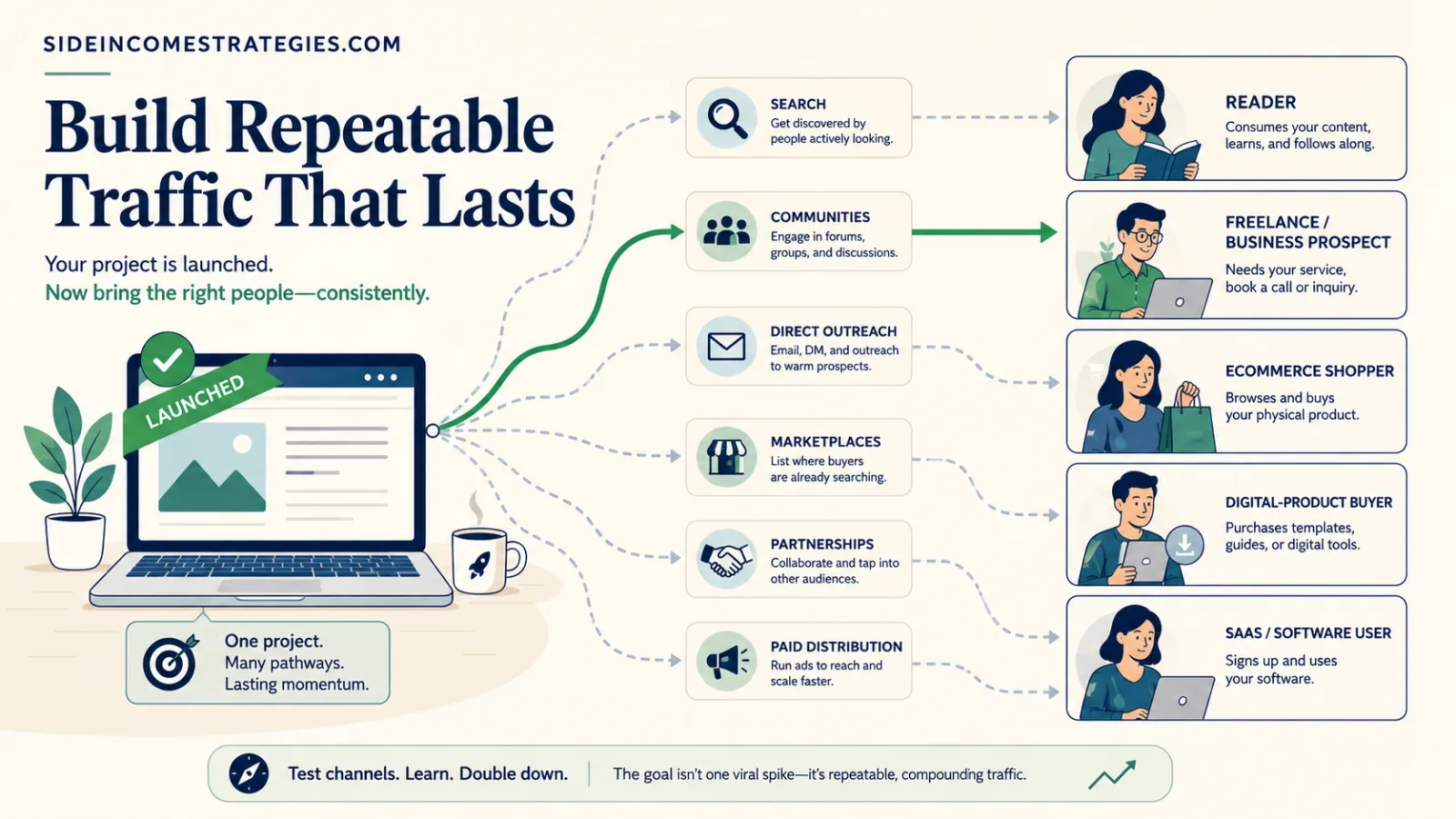
You have chosen a side income model, turned it into something real, and put a first version in front of actual people. The next problem is distribution.
A useful project can still go nowhere if the people who need it never encounter it.
That does not mean opening accounts on every social platform, publishing hundreds of articles, or immediately paying for advertising. It means finding a deliberate way to reach people who are relevant to what you built, testing whether that route produces useful behavior, and gradually making the process repeatable.
On SideIncomeStrategies, that is what TRAFFIC means.
Traffic is not limited to website visitors. Depending on the project, the people you need might be readers, freelance prospects, shoppers, potential buyers, affiliate visitors, or software users.
The objective is not simply to reach more people.
It is to reach more of the right people.
What Traffic Actually Means
The word “traffic” is often used as shorthand for website visits. That definition is too narrow for a side income project.
A freelance business does not need thousands of anonymous visitors if a small number of relevant companies are ready to discuss a project. A SaaS tool needs people who experience the problem it solves, not simply large numbers of pageviews. An ecommerce business needs potential shoppers. A content website needs readers whose interests match the subjects it covers.
The same principle applies across different models: distribution only becomes useful when it connects the project with people who have a reason to care.
| Model | Who You Need to Reach | A Useful Early Response |
|---|---|---|
| Freelancing / Services | Relevant prospects with a problem you can solve | Inquiry, reply, booked call, proposal request |
| Content Website | Readers looking for information you cover | Relevant search discovery, engaged reading, returning visitors |
| Affiliate Project | People researching a problem, product, or buying decision | Relevant visit, merchant click, conversion |
| Digital Product | People who could benefit from the product | Product interest, signup, checkout, purchase |
| Ecommerce | Relevant shoppers | Product engagement, add-to-cart activity, completed order |
| SaaS / AI Tool | People experiencing the problem the software addresses | Signup, activation, continued use, payment |
What Changes After BUILD
During BUILD, the goal was to create the smallest credible version of the project and expose it to real people long enough to get an initial signal.
TRAFFIC begins when the question changes.
Instead of asking:
“Will anyone respond to this?”
you begin asking:
“Can I deliberately create useful exposure again?”
That distinction matters because early validation is often manual and inconsistent. A freelancer may find the first client through an existing contact. A SaaS founder might personally recruit the first users. A new website might receive its first search impressions from a small content cluster.
Those signals tell you that something may be worth continuing.
The TRAFFIC stage begins turning occasional exposure into a distribution process you can understand, test, and repeat.
A Simple Framework for Finding Traffic
There are dozens of possible acquisition channels, but the decision process does not need to be complicated.
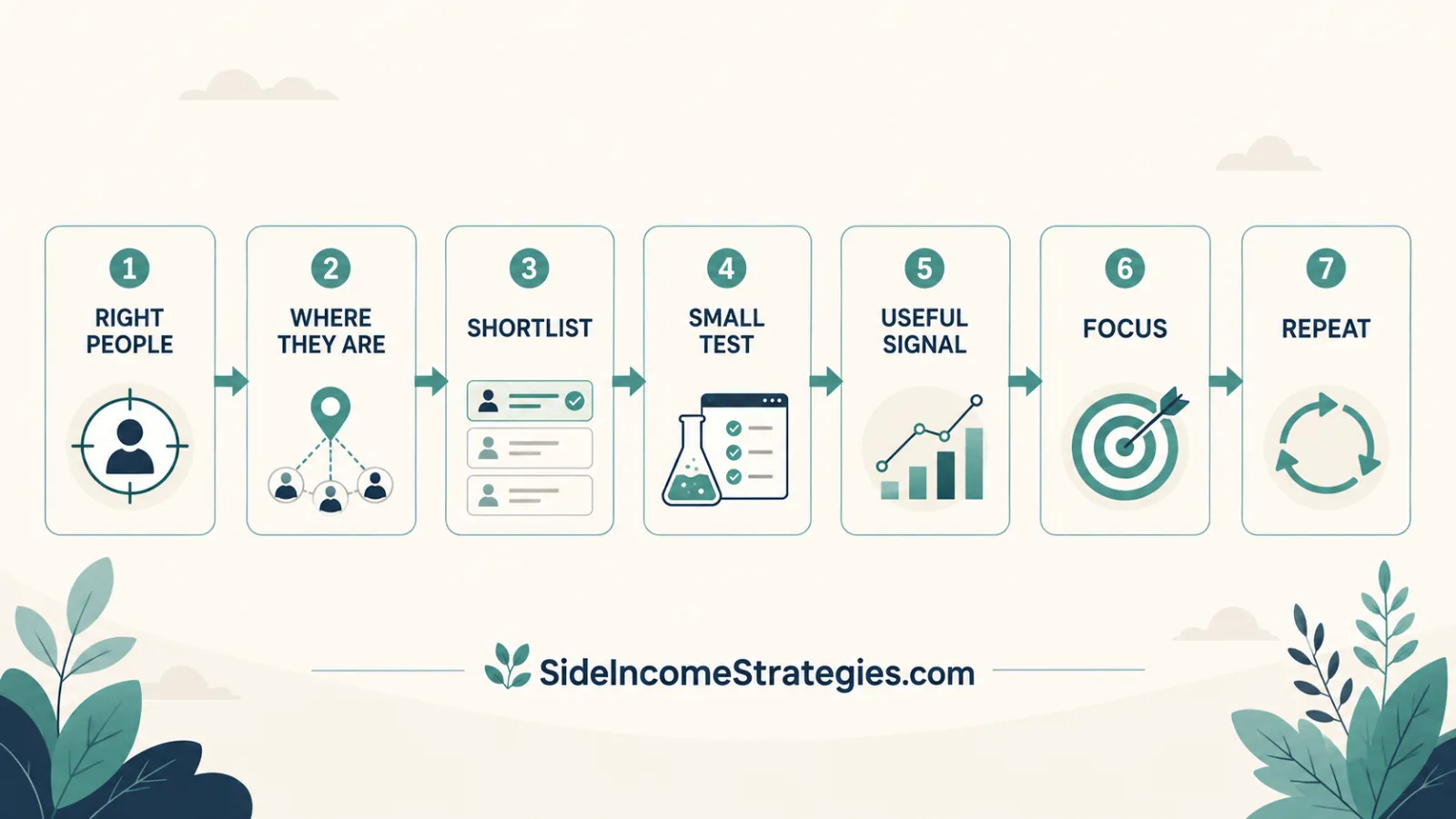
A practical sequence is:
- 1
Define the Right People
Be specific about who needs to encounter the project. “People interested in business” is not useful targeting. “Small ecommerce owners looking for help improving product pages” is much more actionable.
- 2
Find Where They Already Are
Look for places where those people already search, compare, discuss, shop, hire, or solve the relevant problem.
- 3
Shortlist Plausible Channels
Choose a small number of distribution methods that fit the audience, project, available time, and budget.
- 4
Run Small Tests
Test the channel without building an entire marketing operation around it first.
- 5
Measure the Response
Look beyond raw exposure. Did relevant people click, reply, sign up, inquire, buy, activate, or return?
- 6
Choose Where to Focus
A channel that produces meaningful response deserves more attention than one that merely produces activity.
- 7
Make It Repeatable
Continue long enough to understand whether you can deliberately create similar exposure again.
Traffic Looks Different for Different Side Income Models
The framework stays similar, but the channels can look completely different depending on the project.
Someone selling a freelance service may be able to reach potential clients directly. A content publisher may depend heavily on discovery systems such as Google or Pinterest. An ecommerce project may find buyers through marketplaces, creators, search, social platforms, or paid advertising.
That is why copying another business’s traffic strategy without considering the underlying model can waste a great deal of time.
| Model | Possible Early Channels | What You Are Trying to Learn |
|---|---|---|
| Freelancing / Services | Direct outreach, referrals, marketplaces, professional communities | Whether relevant prospects respond to the offer |
| Content Website | Search, Pinterest, relevant communities, content distribution | Whether people discover and engage with the subjects being published |
| Affiliate Project | Search, comparison content, relevant communities, email, selected discovery platforms | Whether commercially relevant visitors reach the content and continue toward merchants |
| Digital Product | Relevant communities, content, partnerships, existing audiences, search, limited paid tests | Whether the product attracts people with enough interest to take action |
| Ecommerce | Search, marketplaces, creators, social platforms, partnerships, paid acquisition | Whether a channel brings shoppers with genuine product interest |
| SaaS / AI Tool | Direct outreach, niche communities, partnerships, integrations, targeted content, search | Whether people with the specific problem become active users |
Where Can the Right People Come From?
Instead of memorizing dozens of individual traffic tactics, it is more useful to understand the main ways people can discover a project.
Search and Discovery
Search engines and discovery platforms can connect a project with people who are already looking for information, products, solutions, or ideas.
Google is the obvious example, but discovery can also happen through platforms such as Pinterest and YouTube.
These channels can compound because useful content may continue being discovered after it is published. The tradeoff is that results can take time, rankings and recommendations are controlled by outside platforms, and competition varies significantly by topic.
Communities and Social Platforms
Communities can provide direct access to groups organized around an interest, profession, problem, or industry.
That might include professional networks, forums, social platforms, specialist groups, or niche communities.
The advantage is proximity to real conversations. The disadvantage is that useful participation usually requires more than repeatedly posting promotional links.
Marketplaces
Some projects can reach customers through platforms where demand already exists.
Freelancers have service marketplaces. Ecommerce sellers have product marketplaces. Software companies may have app and integration marketplaces.
The platform can reduce the work required to find an audience from scratch, but it also controls important parts of the relationship, including visibility, fees, rules, and access.
Direct Distribution
Direct outreach is one of the simplest forms of early acquisition because it removes the need to wait for an algorithm or search engine.
A freelancer can contact suitable companies. A software founder can approach people already discussing the problem the tool solves. A consultant can ask existing contacts for introductions.
This approach is difficult to scale indefinitely, but early in a project that is not necessarily a weakness. Fast feedback can be more valuable than scale.
Partnerships and Earned Reach
Other people and businesses may already have access to the audience you need.
Partnerships, referrals, creator relationships, guest appearances, recommendations, integrations, and media coverage can create distribution without building every audience from zero.
The challenge is that another party must also have a reason to participate.
Paid Distribution
Advertising can buy immediate exposure through search engines, social platforms, sponsorships, creators, and other media.
That speed makes paid distribution useful for some tests, but it does not remove the need for a relevant offer. Paying to send the wrong people to the wrong project only makes the mismatch more expensive.
Paid traffic should therefore be treated as a distribution method, not as proof that demand exists.
How to Choose Which Channels to Test
The best channel is not necessarily the largest one. It is the channel that gives your specific project realistic access to the people it needs.
Before committing significant time or money, ask a few practical questions.
- Are the people I need actually using this channel for something related to my offer?
- What is their intent when they are there — browsing, researching, hiring, comparing, buying, or solving a problem?
- How quickly can this channel give me useful feedback?
- What will a meaningful test cost in time and money?
- Can results continue building over time, or does activity stop when I stop working or paying?
- How dependent would I become on one company, marketplace, algorithm, or account?
- Is this a channel I can realistically continue using if the first test works?
Test a Few Channels, Then Focus
One common mistake is trying to build every distribution channel at once.
A new project does not automatically need a blog, Pinterest account, TikTok profile, Instagram strategy, YouTube channel, newsletter, outreach system, and paid advertising campaign.
At the same time, committing to one channel before testing whether it fits can also be premature.
A better approach is to shortlist a few plausible options and run limited experiments that are small enough to compare.
This is similar to the logic behind the Bullseye framework popularized by Gabriel Weinberg and Justin Mares in Traction: consider the available acquisition channels, test promising candidates, and concentrate resources where traction begins to appear.
For a solo project, the principle can remain simple:
Explore broadly enough to avoid guessing. Test narrowly enough to learn. Focus when the evidence gives you a reason.
What a Small Traffic Test Might Look Like
A traffic test should be large enough to teach you something but small enough that failure is inexpensive.
There is no universal number of posts, emails, ads, prospects, or visitors that makes a test valid. The appropriate test depends on the channel and business model.
Freelancing or Services
Choose one clearly defined service and one realistic prospect group. Test a direct acquisition method such as targeted outreach, a relevant marketplace, referrals, or participation in a professional community.
The useful question is not how many people saw your profile. It is whether suitable prospects responded.
Content Website
BUILD may already have produced a small content cluster. TRAFFIC can test how that content is discovered through search, Pinterest, relevant communities, direct distribution, or another channel appropriate to the subject.
The goal is to learn whether the project is beginning to attract readers who actually match the intended audience.
Affiliate Project
Test distribution around a specific problem, comparison, or buying decision rather than trying to generate broad generic traffic.
Useful behavior may include visitors reaching commercially relevant content, clicking through to merchants, or completing purchases.
Digital Product
Put one real product in front of one relevant audience through a focused channel. That could involve a community, content, partnership, existing audience, search opportunity, or small paid test.
Measure what people do after discovering the product, not just how many impressions the promotion receives.
Ecommerce
Test a defined product or narrow range through one suitable acquisition route such as a marketplace, search campaign, creator relationship, social platform, or limited advertising test.
The meaningful response happens deeper than the click: product interest, cart activity, and completed orders provide increasingly useful information.
SaaS or AI Tools
Look for people already experiencing the problem the software solves. Direct outreach, specialist communities, integrations, partnerships, and targeted content can all be useful early channels.
The strongest early signal is usually not a homepage visit. It is someone becoming an active user and continuing to use the product.
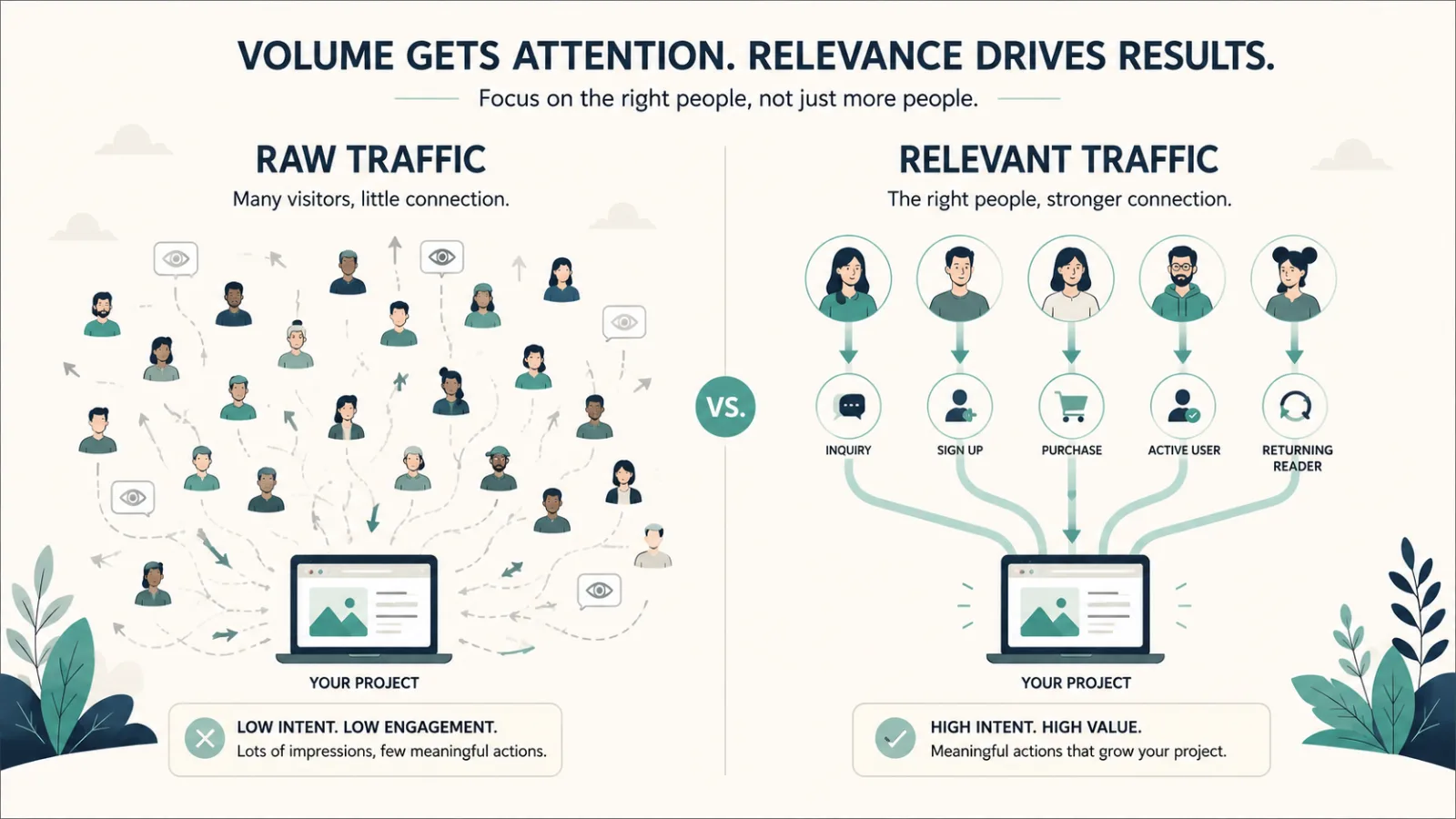
More Traffic Is Not Necessarily Better Traffic
Large numbers are easy to notice.
Impressions increase. Followers accumulate. A post gets viewed thousands of times. Website sessions rise.
Those numbers can help diagnose whether distribution is happening, but they do not tell you whether the distribution is useful.
A smaller channel that repeatedly brings relevant people can be more valuable than a much larger channel filled with people who have little connection to the project.
The correct metric therefore depends on what the project needs.
| Model | Exposure Metric | More Useful Behavior to Watch |
|---|---|---|
| Freelancing / Services | Profile views, post impressions | Qualified inquiries, replies, booked conversations |
| Content Website | Impressions, pageviews | Relevant clicks, engaged reading, returning visitors, continued search discovery |
| Affiliate Project | Pageviews | Relevant merchant clicks, conversions |
| Digital Product | Social reach, landing-page views | Signups, checkout activity, purchases |
| Ecommerce | Ad impressions, product views | Add-to-cart behavior, checkout, completed orders |
| SaaS / AI | Website visits | Signups, activation, retained usage, payment |
Zapier Started With Highly Targeted Distribution
Zapier provides a useful example because its early distribution looked very different from the large-scale content and search presence the company developed later.
Co-founder Wade Foster has described searching online forums for people who were already asking how to connect specific software products. Instead of trying to generate mass awareness, he contacted people who had already expressed the exact problem Zapier was trying to solve.
The early process was manual. Find someone with the problem, explain the solution, get the product working for that person, learn from the interaction, and repeat.
That is useful because it shows what an early traffic channel can actually look like.
The channel did not need enormous reach. It needed access to people with strong relevance.
Later, Zapier could develop additional distribution systems, including content and search. But the early lesson is more basic:
Find where people are already expressing the problem before trying to create attention everywhere else.
Primary-source reading: Wade Foster’s account of Zapier’s first paying customer and Zapier’s discussion of minimal viable distribution
Traffic You Control and Traffic You Depend On
Every traffic channel comes with a different level of control.
You can own a website and the content published on it, but you do not control how Google ranks it. You can build a Pinterest account, YouTube channel, or marketplace presence, but the platform controls its algorithms and rules. Paid advertising gives you access to distribution, but the exposure usually stops when the spending stops.
At the other end of the spectrum, direct customer relationships, subscriber data, your own website, and systems you control can reduce some of that dependence.
This does not mean external platforms should be avoided. They are often extremely useful precisely because they already contain large audiences.
The practical goal is balance.
The Content Website Exception
Content websites create an unusual overlap between BUILD and TRAFFIC because publishing content is both product development and distribution.
During BUILD, a new content project does not need hundreds of articles. A deliberately limited group of useful pages can establish what the site covers, test whether the subjects make sense, and begin producing real-world signals.
During TRAFFIC, the activity may still look like publishing content — but the purpose changes.
Now the project begins to systematize discovery.
That might eventually involve broader topical coverage, keyword research, internal linking, search optimization, Pinterest distribution, link acquisition, partnerships, or other channels.
The distinction is therefore not:
BUILD = write content
TRAFFIC = stop writing content and start marketing
It is:
BUILD = create enough focused content to produce a real first signal
TRAFFIC = develop a repeatable system for helping the right readers discover it
The detailed mechanics of SEO, Pinterest, keyword research, content clusters, and link building belong in separate supporting guides.
What Repeatable Traffic Actually Means
“Repeatable” does not mean guaranteed.
It does not mean every campaign produces the same result, every article ranks, every outreach message gets a reply, or every paid campaign becomes profitable.
It means you understand enough about the relationship between the audience, the channel, and the project that you can deliberately attempt to create useful exposure again.
For example:
A freelancer knows which type of company responds to a particular outreach approach.
A content publisher sees that certain subjects consistently earn relevant search impressions.
An ecommerce seller knows a particular marketplace or creator category repeatedly sends interested shoppers.
A software company knows where people with the relevant problem can be reached and converted into active users.
That is a much more useful milestone than reaching an arbitrary traffic number.
Know When to Stop Adding Traffic Channels
New channels are attractive because they always look like new opportunities.
But every channel creates another system to learn, operate, measure, and maintain.
If one channel is already bringing relevant people, the next question should not automatically be:
“What platform should I add?”
A better question is:
“Have I learned enough from this channel to justify splitting my attention?”
Additional channels can make sense when the first one is becoming predictable, the audience clearly uses another platform, diversification reduces meaningful risk, or a second channel complements what already works.
Adding channels simply because they exist usually adds complexity faster than it adds useful distribution.
When TRAFFIC Becomes MONETIZE
There is no universal traffic threshold for moving to the next stage.
A freelance business does not need 10,000 visitors before thinking about revenue. It may earn money from the first qualified prospect.
An ecommerce store can make sales during its first traffic experiment. An affiliate site may earn a commission before traffic becomes predictable. A SaaS company may have paying users while still figuring out acquisition.
The pathway is therefore not based on whether money has appeared yet.
It is based on what you are trying to improve.
During TRAFFIC, the main question is:
How do I repeatedly get the right people here?
During MONETIZE, the focus becomes:
How do I turn the attention, usage, or customer relationship I already have into more effective and sustainable revenue?
The Traffic Checklist
- 1
Define the Right People
Know whether you need readers, prospects, shoppers, buyers, or users.
- 2
Find Where They Already Are
Look for the places where those people already search, compare, discuss, hire, or buy.
- 3
Shortlist Plausible Channels
Choose a small number that fit the audience, model, time, and budget.
- 4
Run Small Tests
Learn before building a complete marketing system around a channel.
- 5
Measure Useful Behavior
Track actions relevant to the project rather than exposure alone.
- 6
Focus on the Strongest Signal
Put more effort into the route that is bringing the right people.
- 7
Work Toward Repeatability
Learn whether useful exposure can be created deliberately again.
- 8
Add Complexity Carefully
Introduce additional channels when there is a specific reason, not simply because they exist.
Reach the Right People Before You Chase Bigger Numbers
Traffic problems are rarely solved by doing everything.
A new side income project usually has limited time, limited money, and limited attention. Those constraints make channel selection more important, not less.
Start with the people the project actually needs. Find where they can realistically be reached. Test a few plausible routes without turning each one into a permanent commitment. Pay attention to what those people do after they arrive.
Then focus.
A modest distribution channel that repeatedly reaches the right people gives you something you can improve. A large amount of irrelevant exposure usually gives you another number to look at.
Once you understand how relevant people are reaching the project with enough consistency to continue learning, the next question becomes economic:
What is that attention worth, and how should the project turn it into revenue?
That is the MONETIZE stage.
Frequently asked questions
- Do I need a website to get traffic?
- No. Traffic in this framework means reaching the people your project needs. A freelancer may find prospects through outreach or a marketplace, an ecommerce seller may begin on an existing marketplace, and a SaaS founder may recruit early users directly. A website can become an important asset, but it is not required for every acquisition method.
- Should I focus on one traffic channel?
- You do not need to commit blindly to one channel from the beginning. A better approach is to shortlist a few plausible options, run small tests, compare the quality of the response, and then concentrate on the strongest candidate. The goal is focused learning rather than trying to operate every channel at once.
- How much traffic do I need before monetizing?
- There is no universal traffic requirement. Different models can generate revenue with very different audience sizes. The more useful question is whether enough relevant people are reaching the project for you to learn how revenue is created and improved.
- How long should I test a traffic source?
- There is no reliable universal timeline. Some channels, such as direct outreach or paid advertising, can produce feedback quickly. Search and other compounding channels may take considerably longer. Define what useful response would look like before the test and judge the channel in the context of how it actually works.
- Is paid advertising faster than organic traffic?
- Paid advertising can usually create exposure faster because distribution is purchased directly. That does not automatically make it the better channel. Organic channels may require more time but can continue producing discovery without paying for every individual visit. The right choice depends on the project, audience, budget, and purpose of the test.
- What if none of my traffic channels work?
- Recheck the assumptions before simply adding more platforms. The audience may be too broad, the offer may not match the people being reached, the channel may contain the wrong intent, or the test may not have been appropriate for how that channel works. A failed traffic test is information. Use it to decide what needs to change before investing more.
Related guides
Start & Build
How to Build Your Side Income Project: From Model to Launch
Choosing a side income model is only the first decision. The next step is turning that choice into something real without spending months building the wrong thing. This guide shows how to define your first version, test the biggest assumption, build only what you need, launch small, and look for a real signal before investing more.
· 12 min read
Strategies
How to Choose a Side Income Model That Fits Your Life
The right side income model depends less on finding the perfect idea and more on choosing something that fits your time, budget, skills, and expectations. This guide gives you a practical framework for comparing the main options before you commit months of work to one.
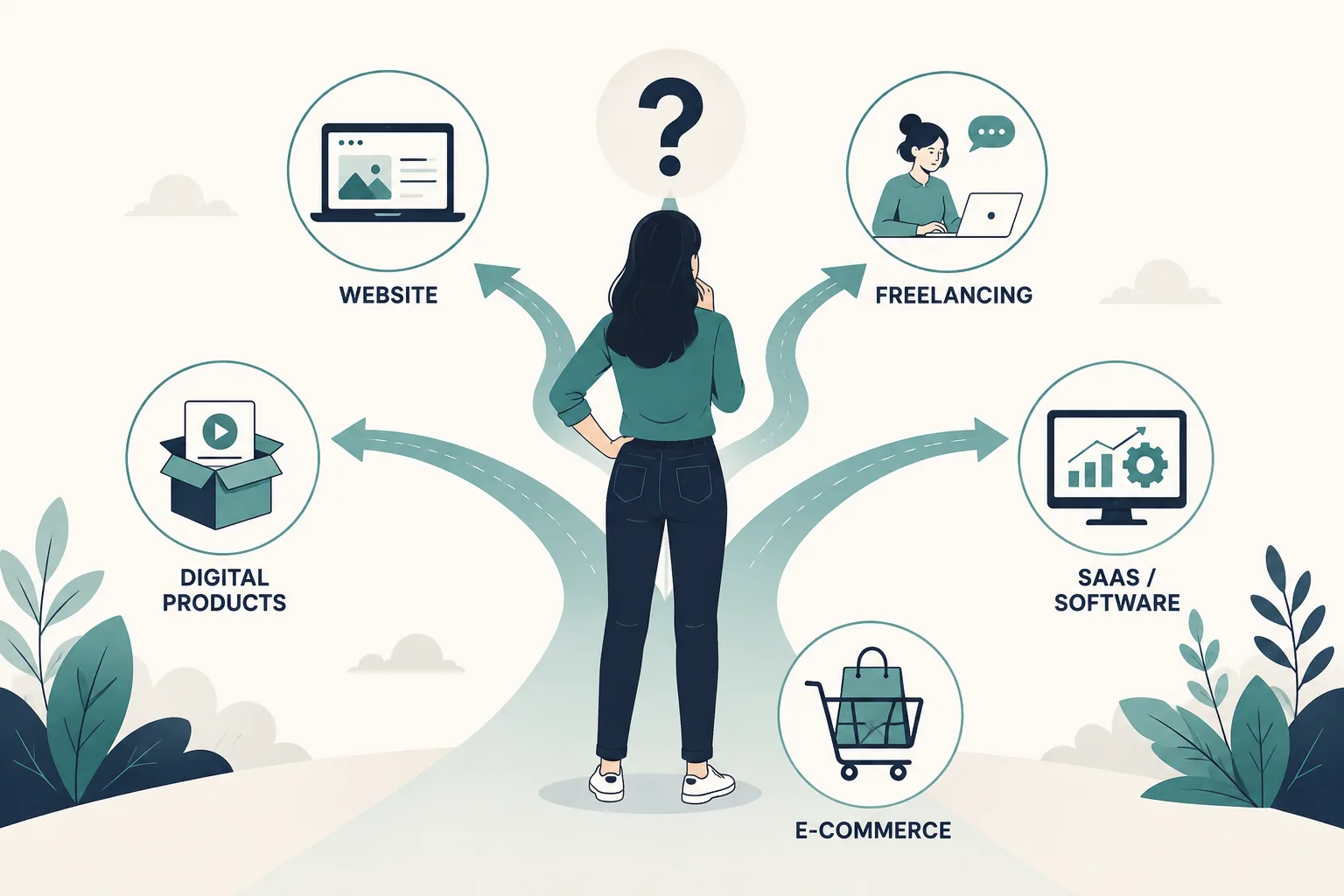
· 10 min read