Start & Build
How to Build Your Side Income Project: From Model to Launch
Choosing a side income model is only the first decision. The next step is turning that choice into something real without spending months building the wrong thing. This guide shows how to define your first version, test the biggest assumption, build only what you need, launch small, and look for a real signal before investing more.
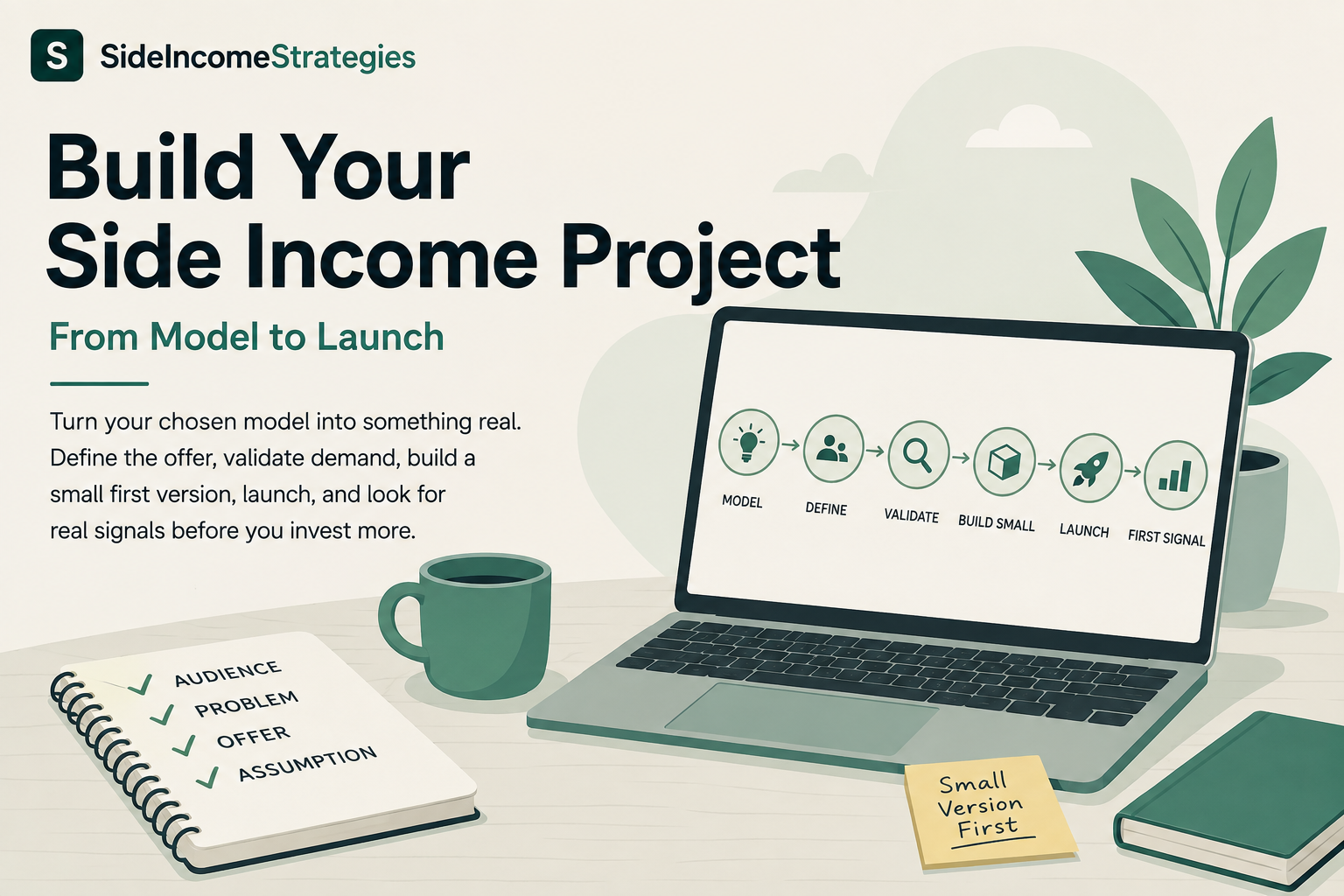
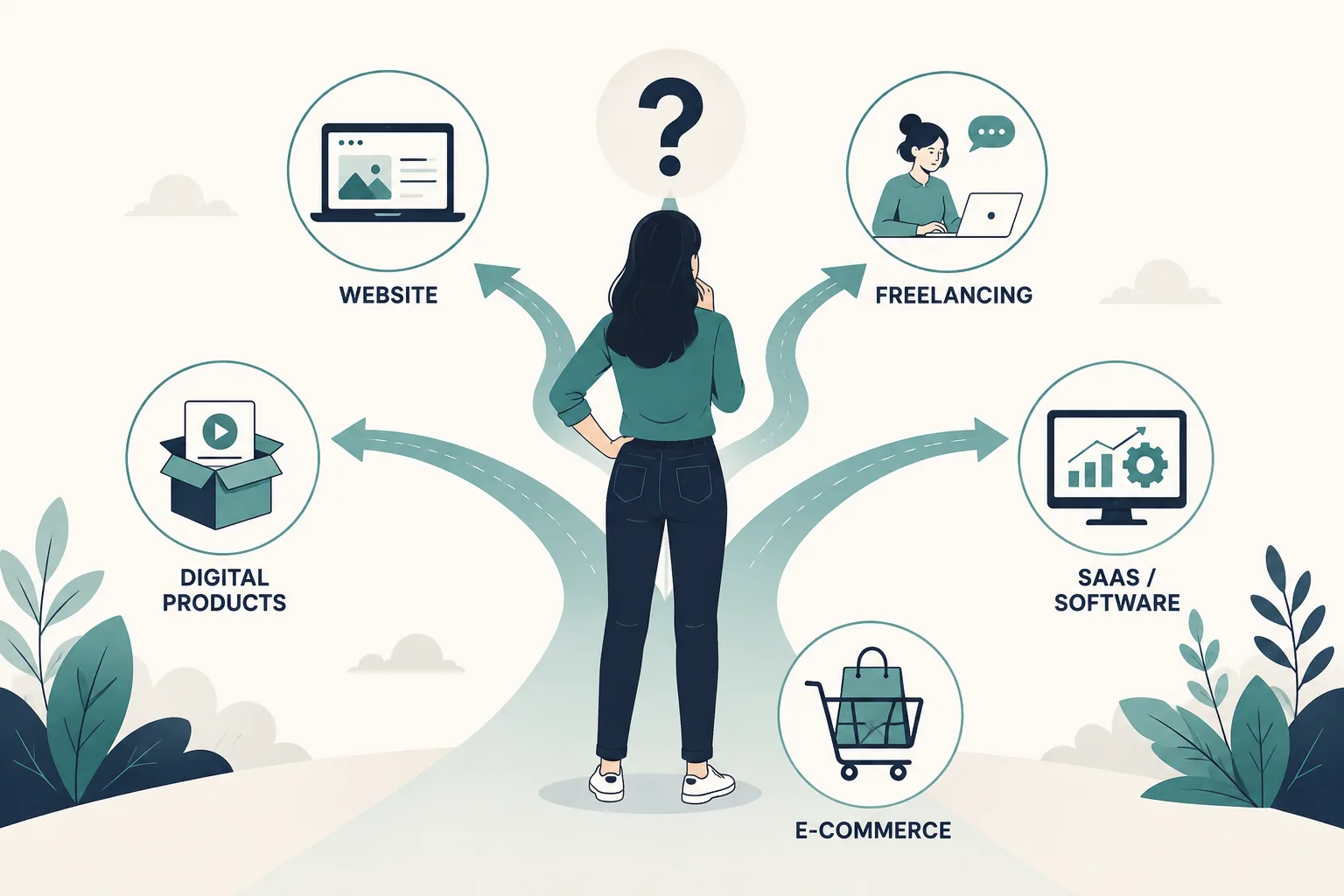
Choosing a side income model gives you a direction. It does not tell you exactly what to build.
You might have decided that freelancing fits your need for faster income, that a content website fits a longer-term asset strategy, or that you want to explore digital products, ecommerce, affiliate marketing, or software.
The mistake at this point is to start building everything.
A new website gets ten pages before anyone has read one. A freelancer spends weeks creating a brand before speaking to a potential client. A software idea grows into a feature list before a single person has tried the core concept.
The Build stage has a different goal:
Turn the model you chose into the smallest credible version that a real person can actually experience.
Then see what they do.
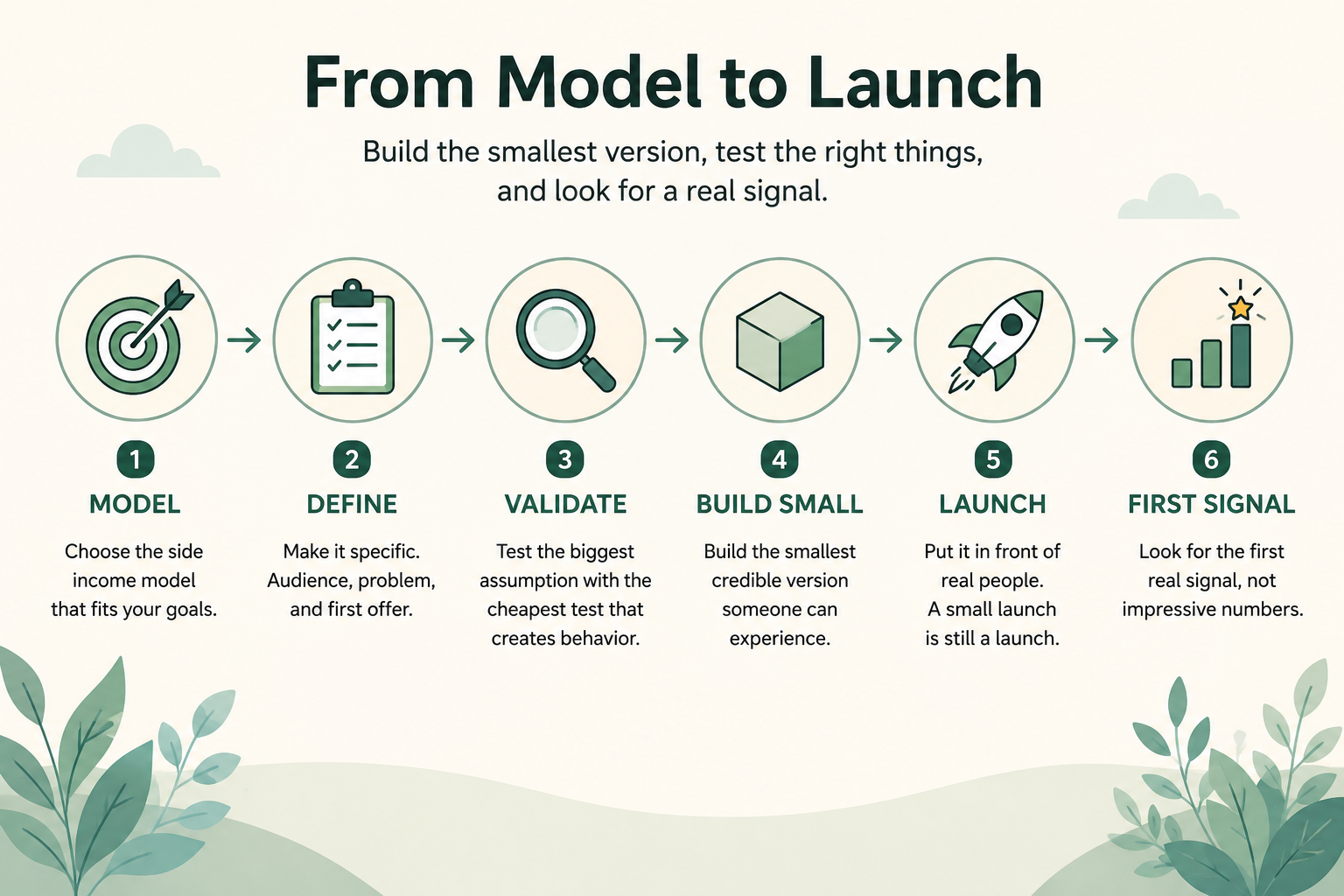
From Model to Something Specific
A model is still too broad to build.
“Freelancing” is not an offer.
“Affiliate marketing” is not a website concept.
“Digital products” is not a product.
“SaaS” is not a problem worth solving.
Before choosing platforms, tools, domains, logos, or software, narrow the project down.
You need four things:
- A specific audience — not everyone who might theoretically be interested.
- A concrete problem or need — something clear enough to recognize.
- A first offer or outcome — what the person actually gets.
- The assumption most likely to kill the idea if it is wrong.
What “Specific” Looks Like Across Different Models
| Model | Too Broad | More Useful Starting Point |
|---|---|---|
| Freelancing | “I’m a copywriter.” | “I write product pages for small ecommerce stores.” |
| Content website | “A personal finance site.” | “A beginner site focused on one specific money problem or audience.” |
| Affiliate project | “I’ll review products.” | “I’ll help a specific audience compare products around one buying decision.” |
| Digital product | “I’ll sell templates.” | “A specific template that solves one repeatable task for one type of user.” |
| Ecommerce | “I’ll start an online store.” | “A narrow product category for a defined customer.” |
| SaaS / AI tool | “Businesses need better automation.” | “One recurring workflow that a specific type of business currently handles badly.” |
The narrower version does not need to become your permanent business.
Its purpose is to give you something concrete enough to test.
Validate the Biggest Assumption Before You Overbuild
Validation does not mean proving that the entire business will succeed.
It means reducing uncertainty before you invest heavily.
The strongest validation usually comes from what people do, not what they say they might do.
Someone telling you “That sounds useful” costs them nothing.
Joining a waitlist or submitting an inquiry requires a little more commitment. Requesting a demo, booking a call, or placing a preorder goes further. Paying for something or returning to use it repeatedly provides much stronger evidence that the underlying problem or offer matters.
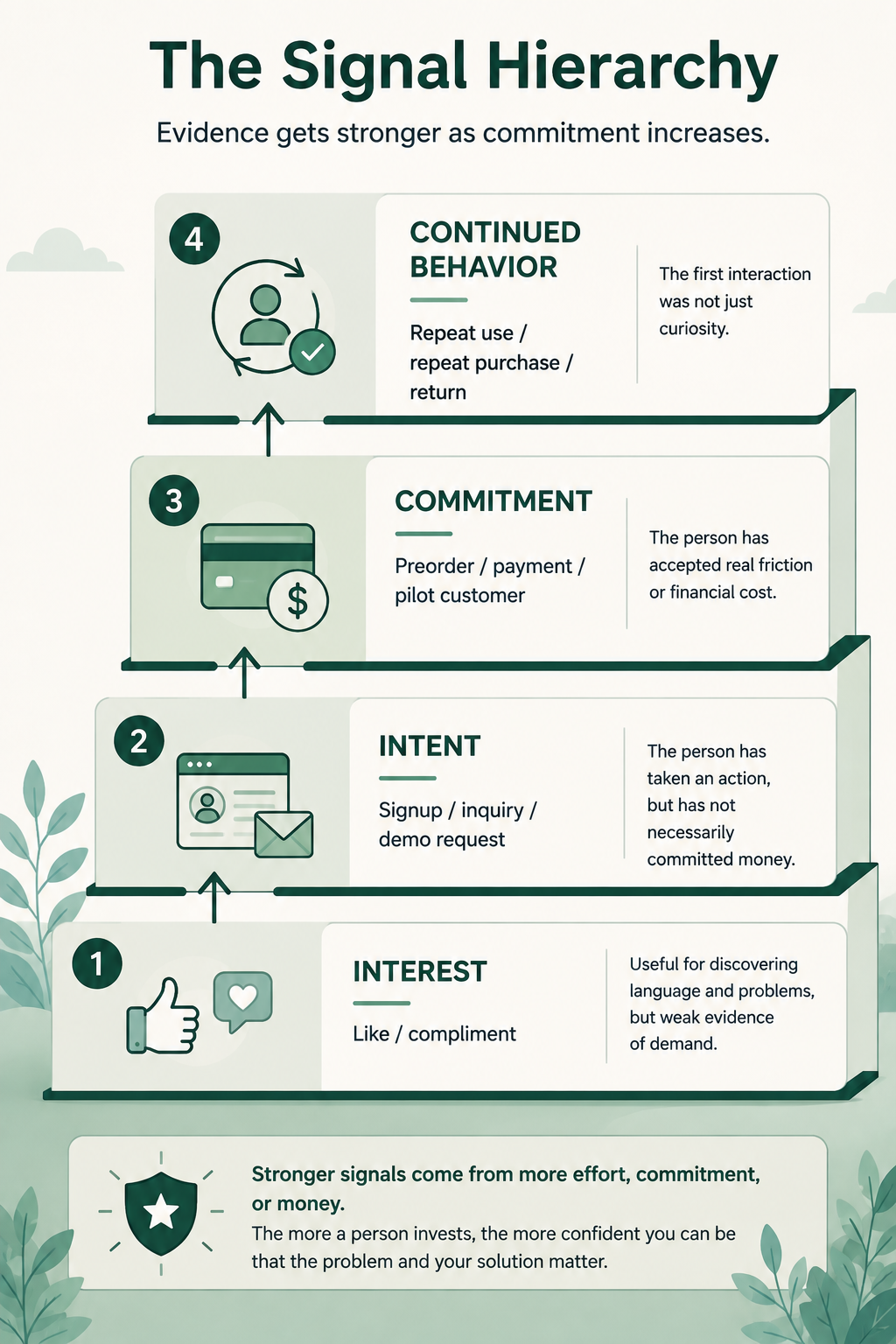
A Simple Hierarchy of Early Signals
- 1
Interest
Likes, comments, compliments, survey responses. Useful for discovering language and problems, but weak evidence of demand.
- 2
Intent
Email signup, waitlist registration, inquiry, demo request. The person has taken an action, but has not necessarily committed money.
- 3
Commitment
Preorder, deposit, pilot customer, completed purchase. The person has accepted real friction or financial cost.
- 4
Continued Behavior
Repeat usage, second purchase, returning readers, continued engagement, renewal. The first interaction was not just curiosity.
Validation Looks Different Depending on What You Chose
The underlying principle is the same across side-income models, but the cheapest useful test is not.
| Model | What You Build First | Low-Cost Validation | Strong First Signal |
|---|---|---|---|
| Freelancing | One clearly defined service | Offer it directly to realistic prospects | Paying pilot/customer |
| Content website | A small, focused content cluster | Search, competitor and community research, then publish | Real impressions/readers and meaningful engagement |
| Affiliate project | Focused content around one problem or buying decision | Check demand, commercial intent and relevant affiliate programs | Qualified outbound clicks / commission |
| Digital product | One useful small product | Landing page, waitlist, preorder or simple paid version | Purchase |
| Ecommerce | Narrow product range or test batch | Preorder, small batch or real purchasing test | Completed order |
| SaaS / AI tool | One core problem solved | Interviews, prototype or manually delivering the result | Repeat usage and/or payment |
The Content-Site Exception
The content-site model is the awkward one.
A freelancer can offer a service tomorrow and discover relatively quickly whether anyone will pay. A digital product can take preorders. Ecommerce can test actual orders.
A content website may require considerably more time before search engines provide useful traffic data.
Keyword research, competitor analysis, search results, communities, Google Trends, affiliate-program availability and commercial activity can all reduce uncertainty. None of them prove that a new website will rank, earn trust, attract meaningful traffic, or make money.
For a content project, those methods are evidence for deciding whether the idea is worth testing — not proof that it will work.
The real test begins when focused content is actually published and real-world data starts to appear.
Build Small Enough to Learn
“Build small” does not mean making something bad.
It means avoiding work that does not yet help you answer the most important question.
The first version needs enough substance for someone to understand or experience the value. It does not need every feature, category, automation, design element, or future revenue stream.
What the First Version Might Actually Look Like
The table above shows the basic validation method. But the actual first version also looks very different depending on what you are building.
Freelancing or Services
Start with one clear outcome.
You do not need an agency, ten service packages, a large portfolio and a complicated onboarding system before approaching anyone.
You need a credible way to explain the service, communicate with a potential client, deliver the work, and get paid.
The business can become more sophisticated after somebody wants the basic offer.
Content Website
A new content site does not need hundreds of articles before you can start learning from it.
Start with an intentional group of useful pages around a tightly defined problem or topic. The goal is to establish what the site is about, publish something genuinely useful, and begin collecting real-world evidence.
The Traffic stage can later expand into systematic SEO, Pinterest, larger content clusters, distribution, and audience growth.
Affiliate Project
Affiliate marketing still needs something useful between the reader and the affiliate link.
A sensible first version focuses on one audience problem, category, or buying decision rather than trying to become a broad authority site immediately.
Before expanding, confirm that relevant products exist, viable affiliate programs are available, and real users actually interact with the commercial content.
Digital Product
Start with one product that solves one problem.
A template, small guide, calculator, toolkit, dataset, or another focused product can give you real evidence before you spend months building a complete product ecosystem.
If the first useful version attracts no meaningful interest, adding five more products does not necessarily fix the underlying problem.
Ecommerce
A large catalog creates more decisions, more inventory risk, more product pages, and more operational work.
A smaller test range gives you a cleaner opportunity to see whether people actually want the product and whether the basic economics make sense.
Expand when the evidence justifies it.
SaaS or AI Tools
Software makes overbuilding particularly easy.
Start with one core job the product should perform. In some cases, you can even deliver part of that result manually before automating it.
If users do not value the outcome when it is delivered manually, automating the same outcome is unlikely to solve the underlying problem.
Build Only the Infrastructure Version One Needs
Infrastructure should follow the project, not define it.
The exact requirements vary by model, but the principle is simple.
Need Before Launch
A first version only needs enough infrastructure to let someone experience what you are offering. That usually means a way to access the project, understand the offer, take the intended action, and receive what was promised. Basic measurement may also be useful when it helps you recognize the first meaningful signal.
Can Wait Until Later
For one project, the minimum infrastructure may be a marketplace profile and a payment method.
For another, it may be a domain and publishing platform.
For software, it may be an extremely small application.
The correct technology depends on what you are building. That is why platform comparisons, hosting, WordPress, AI website builders, ecommerce platforms and similar decisions deserve their own guides rather than taking over this one.
A Small Launch Is Still a Launch
Launching does not require a countdown, advertising campaign, large email list, or thousands of visitors.
The purpose of the first launch is exposure to real people.
A service can launch when you offer it to real prospects. A content site can launch when its first useful content becomes accessible. A digital product launches when someone can actually buy it. A small ecommerce test launches when real customers can place orders. A software product can launch to a handful of early users.
At this stage, a small group of relevant people can tell you more than a much larger group with little connection to the problem you are solving.
Buffer Is a Useful Example of What “Small” Can Mean
Buffer is a useful example because founder Joel Gascoigne documented much of the early process himself.
Instead of immediately building a complete social media product, the idea was initially tested with a simple landing page explaining the concept. A pricing page was later added to see whether interest extended beyond the basic idea.
The early product remained deliberately limited.
After Buffer launched in November 2010, Gascoigne later wrote that the product received its first paying customer within four days.
That matters because the business had produced one of the strongest early signals — somebody was willing to pay — before many features that might normally appear “essential” had been built.
The important lesson is not that every project should copy Buffer's process or expect results within four days.
It is that the first version existed to answer questions, not to represent the finished company.
Read Joel Gascoigne's account of Buffer's early development.
Look for the First Signal, Not Impressive Numbers
Early projects rarely need complicated dashboards.
They need a small number of signals tied directly to what the project is supposed to achieve.
A thousand impressions may look impressive but tell a freelancer very little if nobody asks about the service. A hundred software signups may mean little if nobody returns after the first session. For an affiliate project, raw pageviews matter less than whether readers actually move toward relevant products and eventually convert.
Content sites are slightly different because visibility itself can provide useful early information. Search impressions can show that pages are beginning to appear for relevant queries, while actual readers, engagement and returning visitors provide progressively better evidence that the content is finding an audience.
The point is not to find one universal metric for every project.
Ask instead:
What behavior would make me more confident that this particular project is worth continuing?
A freelancer might be looking for an inquiry that becomes a paid customer. A digital product or ecommerce project can look for an actual purchase. A SaaS or AI tool needs to care about whether people return and use the product, not simply whether they created an account.
The useful signal follows the business model.
Know When to Stop Building
Build does not end when the project is perfect.
It ends when there is enough of a real project for people to react to.
At that point, continuing to add features, articles, products, services, or automation without increasing exposure can become another form of avoidance.
You now need more relevant people to encounter what you built.
That is where the next stage begins.
The Build Checklist
- 1
Make the Model Specific
Define the audience, problem and first concrete offer or project.
- 2
Identify the Riskiest Assumption
Find the thing that would make the rest of the project irrelevant if it turned out to be wrong.
- 3
Test Before Expanding
Use the cheapest realistic method that produces behavior rather than compliments.
- 4
Build the Smallest Credible Version
Include enough for someone to experience the value — and stop there.
- 5
Add Only Necessary Infrastructure
Do not build systems for a scale you do not have yet.
- 6
Put It in Front of Real People
Launch to a small relevant audience.
- 7
Read the First Signal
Look for behavior connected to the business model.
- 8
Decide What Happens Next
Improve something that is already showing promise, change a weak assumption, or stop before investing substantially more.
Build Evidence Before You Build Complexity
A side project does not need to look like an established company on day one.
It needs to become real enough for reality to answer back.
You can always add better branding, more content, additional products, automation, sophisticated tools, advanced analytics, new features, and larger acquisition systems later.
Those things become much easier to justify once you know what people actually respond to.
The first objective is simpler:
Build something small enough to finish, useful enough to test, and real enough for somebody to act on.
Once that happens, the question changes from:
“Will anyone care?”
to:
“How do I get more of the right people to this?”
That is the beginning of Traffic.
Frequently asked questions
- Should I build a website before validating my side income idea?
- Not necessarily. A website may be essential for a content project but unnecessary for an early freelance test or manual software prototype. Build only the infrastructure required to let real people experience or buy the first version.
- How much should I build before launching?
- Enough for someone to understand and experience the core value. The exact minimum differs by model. A freelancer may need one service offer, while a SaaS project may need one functioning workflow and a content site needs an initial useful body of content.
- Does getting positive feedback mean an idea is validated?
- Positive feedback is useful, but it is weaker than behavior. A signup, demo request, preorder, payment, repeat visit or continued product use requires more commitment and therefore provides stronger evidence.
- What if nobody responds to the first version?
- Treat the result as information. Revisit the audience, problem, offer, distribution or assumption you tested before automatically building more.
- Do I need an MVP?
- Not every side project needs software-style MVP terminology. The more useful principle is to build the smallest credible version that allows a real person to experience the value you are trying to create.
- When should I move from Build to Traffic?
- When the project exists in a usable or buyable form and has been exposed to enough real people to produce an initial behavioral signal. Traffic is the next stage: making that exposure systematic and repeatable.
Related guides
Strategies
How to Choose a Side Income Model That Fits Your Life
The right side income model depends less on finding the perfect idea and more on choosing something that fits your time, budget, skills, and expectations. This guide gives you a practical framework for comparing the main options before you commit months of work to one.
· 10 min read